TMC Calibration vs. Magnetic Compass Adjustment
Deviation Diagnosis in Modern Vessel
In my long experience adjusting compasses on board merchant vessels, it has happened to me, from time to time, that my service is required because the captain has alerted that some big deviations of around 10º have been observed.
Normally, on cruise or modern vessels, the main compass is located two or more decks above the bridge.
Therefore, the main compass on the monkey island is not connected physically through a periscope, but is connected via a TMC (Transmitting Magnetic Compass).
This is a sensor (electronic device) used to send the compass headings to the bridge.
Consequently, the officers and the helmsman only see those readings.
If the TMC is not well calibrated, it will show incorrect readings, sometimes with big differences.
The main issue is that neither the officers nor the captain go up to the monkey island to check the compass itself; they only visualize the TMC.
When it is not well calibrated, they presume there are big deviations and the adjuster is informed to correct deviations which do not exist.
Last time, some months ago, I came aboard a cruise vessel and the captain informed me about a 10º deviation.
I went up to the monkey island and observed no deviation at all.
I informed the captain accordingly, and I only had to calibrate the TMC smoothly to solve the problem.
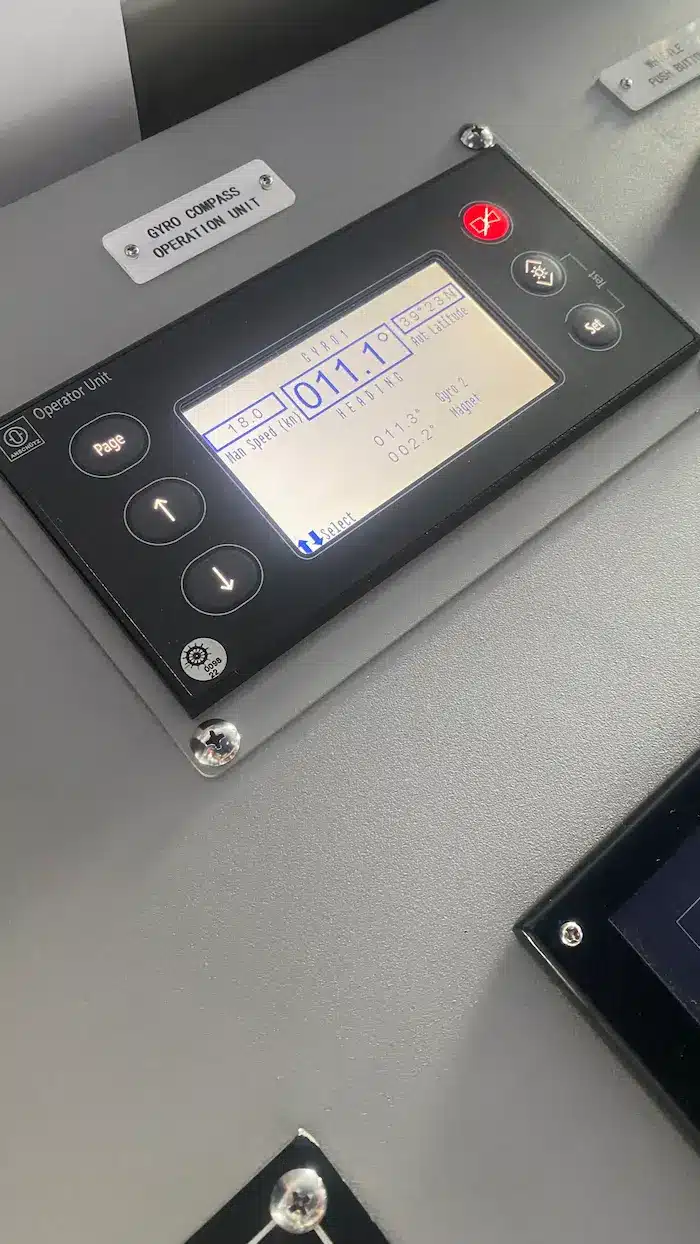
In the phote attached it is noted gyro (true)heading 11.3º and in the area the local variation was 1.5º +, so if no deviation should be magnetic reading 9.8º , but actually the compass reading was 9º, so only around 1.º deviation.
In this particular case the deviation suspected was around 8º and in reality was only 1º.
No swing was necessary, and no boat was needed to pick me up, so a lot of money was saved.
CAPT. A.ROS COMPASS ADJUSTER Nº 86 BY DGMM (SPANISH ADMINISTRATION)