How to adjust the magnetic compass
In the age of GPS and satellite positioning, the magnetic needle remains the only autonomous navigation instrument that does not depend on electrical power or external signals.
Components of Earth's magnetism: Why does the nautical compass deviate?
In any point of the earth any line of force is determined by its 3 components: Intensity (total magnetic field of the earth F), magnetic dip and magnetic declination.
The total force is vectorially decomposed in two directions, one the horizontal H and the other the vertical Z, the most important one is the first H, which is the one that orientates the compass. The angle that forms H with the true meridian Nt it is called magnetic declination or local variation.
The line which joins the points with cero inclination and Maximo force horizontal defines the magnetic equator.
The minimum values of F are located near of the magnetic equator. The maxima values of H are in the magnetic equator and cero in the magnetic poles, and this is the reason why that the compasses which work by H have weak orientation force in high latitude and strong one close to the magnetic equator. On the contrary Z, its value is Maximo in the magnetic poles.

Key concepts before starting the magnetic compass adjustment:
Magnetic declination (dm):
The angle between true north and magnetic north, which varies depending on the geographical position.
Deviation (Delta):
The error caused by the ship's own magnetism (permanent and induced).
Total Correction (Ct):
The algebraic sum of the decline and the deviation (Ct = dm + \Delta).
LOCAL VARIATION OR MAGNETIC DECLINATION. ITS CORRECTION
It is the angle in any point of the earth between the magnetic meridian and the geographic one (true north).
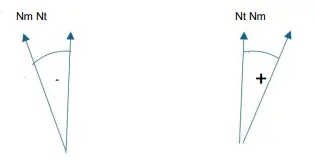
Its values are in the nautical charts with the indication of the year.
SHIP MAGNETISM
In the construction of the vessels there are many materials sensitive to acquire magnetism under the action of the earth magnetic field.
The acquired magnetism is classified in permanent (a lot of carbon) and induced (bit carbon). Also, there are materials which have in between permanent and induced (intermediate).
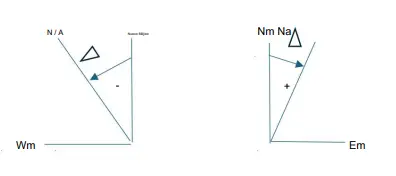
DEVIATIÓN 🔼
It is the angle between the compass north and the magnetic north. It is evident that if the vessels were built with non-magnetic materials there would not have any deviation. The goal of the adjustment is to reduce as much as possible the said deviation.
DIFFERENT SHIP’S HEADINGS
As there are north, magnetic, and compass meridian as reference, as a result there are true, magnetic and compass headings.
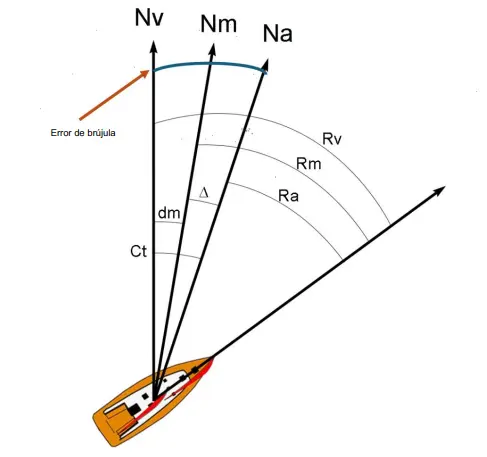
TRUE HEADING = Magnetic heading +local variation
TRUE HEADING = Compass heading +local variation deviation
TRUE HEADING = Gyro heading + gyro error
MAGNETIC HEADING = Compass heading +deviation. If no deviation
MAGNETIC HEADING = COMPASS HEADING
Compass error = local variation + deviation
THEORY OF MAGNETIC COMPASS ADJUSTMENT
Magnetic adjustment.
The compass when it is installed in steel ship must be adjusted for the ship’s magnetic condition that its operation approximates that of a nonmagnetic ship
Deviation is defined as deflection of the card needles to the right or left of the magnetic meridian. Adjustment of the compass is to proper installation, about to the compass either in a binnacle or close to the compass of magnetic and soft iron correctors so that their effects are equal and opposite to the effects of the magnetic material of the ship, reducing the deviations.
The magnetic conditions in a ship which affect a magnetic compass are permanent and induced magnetism.
In a compass installed in a binnacle, which is the normal installation in a ship dedicated to commercial operations, like loading and discharging goods. The permanent magnetism is corrected with the fore & aft, athwartship and heeling magnets and the induced magnetism is corrected with the spheres and the Flinders bar. The fore & aft permanent magnets(B)only correct E-W magnetic headings and do not affect the N-S magnetic headings, and the athwartship permanent magnetic (C) only correct N-S magnetic headings and do not affect the E-W magnetic headings.
The induced magnetism varies with the strength of the surrounding field, the metal of the vessel and the alignment of the metal in the field. Since the intensity of the earth’s magnetic field varies over the earth’s surface, the induced magnetism in a ship will vary with latitude, heading, and heel of the ship.
With the ship in an even keel the resultant vertical induced magnetism will create deviations. As long as the vessel is in the same magnetic latitude its vertical induced pole swinging about the compass will produce this same effect on the compass as a permanent pole swinging about the compass.
The magnitude of these deviations will change with magnetic latitude changes because the directive force and the ship’s vertical induction both change with magnetic latitude.
The masses of horizontal soft iron are subject to induced magnetization and symmetrical arrangements of horizontal soft iron exist about the compass .The deviation resulting from the earth’s field induction of these symmetrical arrangements of horizontal soft iron are called D deviations and are maximum on the intercardinal headings (NE,SE,SW and NW) and zero on the intercardinal headings.
These quadrantal deviations are corrected with the spheres or in Japanese compasses with boxes which have plates inside. The main point in these quadrantal deviations is that they do not vary with latitude changes because the horizontal induction varies proportionally with the directive force.
PROCEDURE FOR MAGNETIC COMPASS ADJUSTMENT
Berth tests and adjustment
Before we start any adjustment at sea, we have to be sure about the following points which we have to check when the vessel is alongside.
Phisical checks on the compass and binnacle
a/ If there is any bubble and it is not very big, we must remove it. If the bubbles are big or there are many of them, it means that the compass is damaged and must be repaired. We have to ask the captain for the spare compass to be installed (if any)
b/ Remove any slack in gimbal arrangements.
c/ Test for sensibility of the compass performed with a magnet. It is made writing down the actual magnetic heading and then approaching the magnet to the compass. If the compass does not recover the previous heading in, let us say, few seconds or it is blocked, it means that the compass is damaged and must be repaired.
d/ Magnetization check of the spheres and Flinders bar. Sometimes it is difficult to adjust the compass since the spheres (overall) are magnetized, for this reason is better to check this possibility, i.e. Move the spheres as close to the compass as possible and slowly rotate each sphere separately. Any appreciable deflection, more than 2º, of the compass needles resulting from this rotation, means that the spheres have residual magnetism. With the Flinders bar is rarer but if any doubt, note the compass heading with the Flinders bar in the holder, invert the Flinders bar and again note the heading. Any appreciable difference of more of 2º indicates magnetism. Spheres and Flinders bar with magnetism should be heated to a dull red and allowed to cool slowly, but also could be strike between them and like this could lose the residual magnetism. If not, it is better not to install the spheres.
e/ Open the binnacle and see (write down) where the permanents magnets are, fore & aft, athwartship and heeling magnets. This is of paramount importance since some times the magnets have been changed by an unprofessional or maybe by a crew member who does not the procedure or they have fallen because they were not protected.
Important data.
f/ check the local variation.
h/ If it is a small yacht, see the leading lines available.
i/ If the adjustment will take place in a merchant vessel, the adjustment will be performed with gyro, in this case it is of paramount importance to be sure about the gyro error. Check it with the true heading of the berth where the vessel is alongside.
Adjustment at sea
In a merchant vessel this is performed using the gyro, which is the best way, always knowing the error (if any), swinging from heading to heading slowly, starting, if possible, with E or W magnetic, which is, normally the biggest one.
1/The heeling magnet should be checked, though it is better not to change, only if it is too close to the compass it is necessary to lower so as do not affect the compass.
Normally the polarity is red up. So, avoid the adjustment of the heeling magnet which is quite impossible to perform in a merchant.
2/Correct the cardinal magnetic headings, starting with the east magnetic, this is the most preferable.
Come to this magnetic 090º, insert fore and aft B magnets if is the first time or it is necessary, or move the existing B magnets in such a manner as to remove all deviation.
3/Come to a south magnetic heading (180º). Insert C magnets (athwartship) if necessary or move the existing C magnets, in such a manner as to remove all deviation.
4/Come to a west magnetic heading (270º). Correct half of any observed deviation by moving the B magnets. If the residual deviation is small, leave it as it is, for instance 2º or 3º.
5/Come to a north magnetic heading(000º). Correct half of any observed deviation by moving the C magnets, also if the deviation is small, leave it.
All the cardinal has been adjusted, in a small yacht this is the only adjustment available, since there are not spheres neither the yacht has induced magnetism, so only check and write down in the certificate.
6/Come to any intercardinal heading (045º) and correct any deviation by moving the spheres in or out. Normally most of the vessels have spheres (CPLATH / SPERRY or CASSENS & PLATH).
The Japanese compasses like NOUNOTANI, TOKIMEC & SAURA have instead boxes which inside there are plates to be inserted.
7/Come to the next intercardinal magnetic heading., (135º) and correct half of any observed deviation by moving the sphere.
Also, if the deviation is small, leave it. You can also check the two which remain (225º and 315º) and write down the deviations.
8/Secure all correctors and take a photo of them and write down where are installed. This is of paramount importance to issue the new deviation card.
PRACTICAL PROCEDURES FOR MAGNETIC COMPASS ADJUSTMENT
Dockside tests and adjustments.
As explained many physical checks are essential before starting the adjustment at sea. It will save a lot of time and errors.
If the compass has any small bubble, it must be fill with the proper fluid. In this case take care since it is important to know which one is to be added.
Sometimes distilled water, sometimes special fluid which normally the adjuster if it was not advised he will not have. If you fill with an inappropriate fluid, you can cause a big damage inside the compass.
If the bubble is big, the compass must be sent to be repaired since the membrane or any seal gasket is damage and the compass is leaking, (most probably).
Regarding the test of sensibility just be sure that the compass card returns to the same reading after deflection.
Correct alignment of the lubber’s line of the compass with the fore & aft of the ship is of paramount importance, nevertheless when an adjuster goes to a vessel which has the compass already adjusted, it is assumed that is aligned, only if the binnacle must be installed due to is a new ship, in this case the alignment must be done properly.
The Flinders bar is installed when the vessel was built and the adjuster has nothing to do in this matter, only use an empirical amount of Flinders bar (30 cm). If the length is not the appropriate,the compass will have deviations in the headings E-W when the vessel changes a lot of in latitude (30º or more).
So, the Flinders bar is left as it was and the sphere also in its position (if the compass has been adjuster previously).
The B error results from two different causes, the fore & aft permanent magnetic field across the compass and an unsymmetrical vertical induced effect forward or aft of the compass.
The former is corrected using fore and aft magnets (B), and the latter using the Flinders bar. Inasmuch as the Flinders bar setting has been made at dockside, any B error remaining is corrected with the permanent magnets. (fore & aft).
The C error has two causes, the athwartship permanent magnetic field across the compass and the unsymmetrical vertical induced effect athwartship of the compass.
The former is corrected by the use of the permanent magnets B (athwartship) and the latter with the Flinders bar port or starboard side of the compass, but this error is very rare, the C error is only corrected with the C magnets.
The D error is due only to induction in the symmetrical or horizontal soft iron, and it is corrected by the use, only, of the spheres athwartship of the compass.
To sum up the discussion above reveals that certain errors are rare, others have been corrected at dockside. Therefore, for most ships, there remain only three errors to be corrected at sea, the B, C and D errors.
These are corrected using fore & aft (B), athwartship(C) magnets and quadrantal spheres for the D error.
Adjustment procedures at sea
Before proceeding with adjustment at sea take the precaution to of secure all effective magnetic gear, like cranes or MacGregor hatch covers, in the normal seagoing position.
The adjustment is made with the ship in even keel, swinging from heading to heading slowly and steadying for two minutes in each heading.
The adjustment is performed by trial and error and is desirable to start with B error since is generally the greatest . The last step, after completion the adjustment, is to secure all the correctors in the position the adjuster has finally installed and issue the magnetic compass adjustment certificate in order to give it to the master.
It is advisable to prepare the document with all possible details of the vessel, such flag, IMO, etc. and only to fill the deviations obtained and the position of the correctors.
The adjuster has to keep in mind that after completed the adjustment not many times is left, since always the ships are in a hurry and the captains want the certificate on board before the adjuster disembark.
Corrector effects
If a ship have spheres and many permanent B and C magnets correctors close to the compass, there will be a condition of induction between these correctors which can cause the magnetism of the spheres and Flinders bar which will create some difficulty during the adjustment.
This situation can be improved by using more magnets further from the spheres and compass and using larger spheres further out in the brackets.
Regarding the Flinders bar is generally impossible to place the corrector amount of it.
The only correct way is as follows: In the position of magnetic equator the Z=0 and then there is not vertical induced magnetism.
1.Take out all pieces of Flinders bar.
2.When the ship crosses the magnetic equator head to Em or Wm
3.Correct all the deviation with fore and aft magnets
4.When the ship is in other part of the ocean, around 20º or 25º more in latitude, head to Em or Wm
5.Correct all the deviation with the Flinders bar. This will serve for all latitudes.
Of course the adjuster is not able to proceed this way for obvious reason, but it is advisable to advise the captain that if the vessel is going to change a lot in latitude, it could be possible that it will be observed big deviations Em and Wm.
Methods of placing ship on magnetic headings
The primary object of adjusting compasses is to reduce deviations, to make the magnetic heading and the compass heading identical or as nearly as possible.
The preferred method is to place the ship on the desired magnetic heading using the gyros which, nowadays, are completely reliable and very accurate and using this method will save time and money.
The deviations of the compass are easily observed as the difference between the compass reading and the known magnetic heading of the ship.
The procedure to place the ship by reference to a gyrocompass is as follows:
The magnetic variation is applied to the true heading to determine the gyro course to be steered in order to place the ship on the desired magnetic heading.
The local variation can be found in the local chart or in magnetic-declination .com or in NOAA Mobile Magnetic Declination Calculator (NGDC..noaa.gov) ,this application also will serve to check on board the true deviations observing the headings (True heading, compass heading and gyro heading)written in each watch by the officers.
If the gyro has any error, it must be taken into consideration.
When the adjuster is going to a vessel it is of paramount importance to
8/When the adjuster is going to a vessel it is of paramount importance to to prepare the relationships well tabulated with the local variation of the area where the adjustment is going to be performed
For instance, in an area of local variation of 4ºW and gyro error of 1º E, you have to tabulate as follows:

Other method for obtaining the deviations is by comparison of the calculated magnetic azimuth of the sun and the azimuth as observed on the compass by use of an azimuth circlet.
This method takes a lot of time and almost never is used by an adjuster.
9/For the small yachts which are built in fibre it is advisable to use leading lines or other compass in good condition and compare.
Also, GPS, if any, can be used always considering the local variation of the area where the compass is to be adjusted.
If for instance, the leading line is 180º (true) and you head to this leading line with the compass and it is showing 176º, it means that the total error is 4º+.
If the local variation is 2º +, then the deviation will be Total error = local variation + deviation;4º=2º+deviation. deviation = 2º + and so on….
Compass error = local variation + deviation
True heading = Magnetic heading + local variation
Magnetic heading = Compass heading + deviation
True heading = Gyro heading + gyro error if no error True heading = Gyro heading
Different types of compasses to be adjusted.
1/Compasses in small vessels normally built in fibre and consequently no magnetic fields around the compass (most probably) although sometimes there are some electronic devises close to the compass which makes the adjustment very difficult or even impossible…
These compasses do not have any binnacle to install any magnet if necessary and have to be adjusted with the screws or wheels inside the compass.
There are two, longitudinal (E-W) and transversal (N-S). The quadrantal headings cannot be adjusted if any deviations, but to state.
The procedure is with a leading line (must be known) or with the heading of the pier, which must be N-S-E-W or with the GPS taking care do not observe big wind or current.
These ships built in Fiber, normally, do not have big deviations.
2/Compasses in large yachts built in steel
The compasses, normally, are like the ones in big merchant vessels, but are hanging in the ceiling and do not have any binnacle with the appropriate correctors.
To adjust these compasses, first, the adjuster has to find out the magnets, if any, around the compass and introduce your head close to the compass to see them…sometimes it is very difficult.
Also, they do not have spheres or Flinders bar and consequently in the quadrantal headings, sometimes, it is observed big deviations…
3/Compasses in merchant vessels
These compasses are the easiest to be adjusted, since there is a binnacle with their trays numbered to install the permanent magnets (fore &aft and athwartship magnets) to correct the cardinal headings, the spheres to correct the quadrantal headings, heeling magnets which correct the deviation when the vessel sails with list and finally the Flinders bar, which correct the part of the coefficient B due to the vertical induced magnetism which change with the latitude.
The best way to adjust .as previously stated, is the gyro and it is of paramount importance to know the true error of the gyrocompass, if not, it could be to adjust in a bad way with, maybe, 3º or more degrees of error and consequently perform an spurious adjustment
10/Approximate coefficients and the mathematical expression for the deviation on any heading
DEVIATION =A+B sin Ra+C cos Ra+ D sin 2 Ra+ E cos 2 Ra ; Ra = Compass heading.
This formula comprise 3 parts clearly differentiated in the way their effects are noted, and are known as constant deviation A, semicircular deviation B and C quadrantal deviation D and E deviation.
To calculate the values of the coefficients, apply the formulas:
A=1/8 ALL DEVIATIONS; B=E-W/2; C=N-S/2;D=(NE+SW)-(SE+NW)/4;E=(N+S)-(E+W)/4
These coefficients are calculated after the adjustment is performed and more than 3º means that the adjustment is defective, or the magnetic field of the vessel is abnormal.
Preparation of magnetic compass deviation card
It is of paramount importance to have the documents, service report and the magnetic compass adjustment certificate ready to be hand over to the captain, only the details like the time and the deviations values, of course, will be missing and will be introduced after completion of the job.
The ship cannot wait for these documents too long since, maybe, she has a shift in the next port.
Prepared by Capt. ROS. Compass adjuster nº 86 by DGMM (Spanish administration)
FAQ´S
How often a compass must be adjusted?
It is recommended to do it annyaly or when the flag asks for (normally every two years), or after major structural repairs, installations or new electronic equipment close to the binnacle, or if the vessel has been laid up for a long time in the same heading.
Can I use the gyro to adjust the compass?
Yes , it is the preferred method nowadays. You have to compare the true heading with the compass heading and take into account the local variation or declination.
What is the Flinders bar and what is it used for?
It is a vertical soft iron cylinders (different lengths to be inserted) that correct the deviation caused by vertically induced magnetism, which changes drastically when the vessel significantly changes its latitude. It is important to note, that for vessel which do not change a lot in latitude ,like costal vessels, the Flinders bar is not needed.
CAPT. A.ROS COMPASS ADJUSTER Nº 86 BY DGMM (SPANISH ADMINISTRATION)